The South Asia Regional Initiative for Energy Initiative (SARI/EI) program is the regional energy program of USAID covering eight countries of the region: Afghanistan, Bangladesh, Bhutan, India, the Maldives, Nepal, Pakistan, and Sri Lanka. Started in the year 2000, the program has consistently strived for promotion of energy security in the South Asian nations by working in three focus areas: 1) cross border energy trade, 2) energy market formation, and 3) regional clean energy development.
The SARI/E Energy program in year 2012 entered into its fourth and final phase, SARI/Energy Integration (SARI/EI). In this phase (2012-2017), the project goal is to advance regional energy integration and project purpose is to increase cross-border energy trade through focus on the following three components: (consistency required in the tenses)
1) Harmonization of Policy, Legal, and Regulatory mechanisms
2) Advancement of Transmission Systems Interconnections
3) Establishment of South Asia Regional Electricity Markets
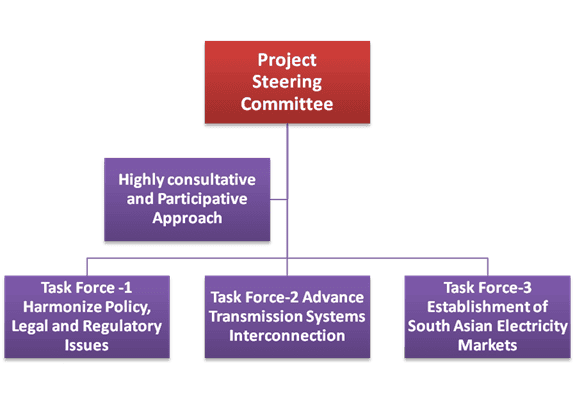
The program would catalyze enabling systemic conditions for regional energy integration through formation and support to three Task Forces (TFs) focusing on three components mentioned above.
The representatives of regional stakeholders like national governments, national power transmission utilities, national electricity regulatory commissions, power market institutions, and other in-country organizations will be the members of the Task Forces. TFs will showcase examples of the benefits of regional cooperation, leverage counterpart funding and resources, provide unbiased support for regional initiatives, present a platform to discuss cross-border trade, and promote infrastructure interconnections. TFs will also help create markets and mechanisms for transparent trade practices, clean energy access, efficiency, conservation and renewable sources.
The Project Steering Committee (PSC) is program’s apex body and provides overall strategic direction. The PSC comprises – senior representation from the country governments of individual SARI/EI countries, independent energy experts/diplomats, representatives from the regional institutions like SAARC Energy Center and multilateral donors like the Asian Development Bank.
The U.S. Agency for International Development (USAID) selected the Integrated Research and Action for Development (IRADe), through a competitive process, for the implementation of this phase of the South Asia Regional Initiative for Energy Integration (SARI/EI) program. IRADe’s approach would be to actively act both as the secretariat and technical input provider, and work towards consensus building amongst member countries for the program objectives in a constructive manner.
The activities of the Task Forces form the heart of the program. Task Force meetings will be focused, structured, demand-driven and resulting into tangible outcomes. The process of guiding the TFs through their work will be supported by demand driven research and analysis. The requirements for technical analysis, study, and research evolved during the discussion in the TF meetings will be promptly responded to. Thus, the members will be assisted in their decision-making process so that they can make informed recommendations on the issues of cross-border energy trade.
Key Recommendations
Renewable Energy Certificates (RECs):
- Ensuring policy certainty and regulatory compliance by demonstrating a national policy commitment for RECs by setting appropriate targets that aligns with the national level targets of renewable energy generation.
- Setting uniform RPO targets across states in India , set Minimum Price guarantee for RECs and strengthening the penalty mechanism
Green and energy efficient building standards:
- Promote the uptake of green and energy efficient building standards by incentivising owners and developers to overcome barriers related to capital intensity, high cost and general reluctance to move from existing practice. Central financial assistance could be provided to city municipalities and other local bodies to finance these incentives.
- Reduce the knowledge gaps and promote greater sharing of information amongst technical experts and developers to incorporate Green building/ energy efficiency techniques in building design and construction.
- Stricter regulatory provisions and mandating standards for making designers and contractors for rapid adoption of techniques and technologies for green and energy efficient buildings.
Low carbon governance and institutional framework:
- A special unit such as the Low Carbon Growth Unit (LCGU) could be set up in planning commission to focus expressly on delivery of those aspects of the 5-Year Plan with climate elements linked to the NAPCC.
- A new dedicated committee was established by the Prime Minister, under the PM Council, to track the progress of the NAPCC Missions with clear recommendations of what improvements can be made.
- Improving the institutional framework to support private sector action