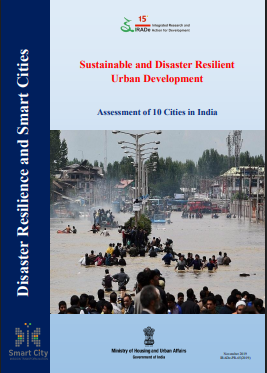
With the increasing unplanned urbanization, their impacts are increasing, which is primarily associated with poorly planned and unmanaged urban development, degraded ecosystems, and poverty. Unplanned urbanization has been a challenge, increasing the vulnerability of cities to natural as well as man-made hazards. As per the 2011 census, 31% of India’s population lives in urban areas (GoI). According to the United Nations Population Fund’s State of the World Population Report, 2007, by 2030, 40.76% ofIndia’s population will live in its urban area. According to a study by the United Nations, almost 890 million people across the globe (60% of the global population) live in cities that are at risk of at least one major natural hazard —floods, droughts, cyclones, or earthquakes (UN 2012). In 2011, 80% of global disaster-related economic losses occurred in the Asia and Pacific region. Though only 40% of all disasters triggered by natural hazard events in the world occur in Asia, 88% of affected people reside in this region (ADB, 2013).
Disaster is defined as an event or a series of events that give rise to casualties and damage or loss of properties, infrastructure, environment, essential services or means of livelihood on such a scale which is beyond the normal capacity of the affected community to cope with. Disaster is also sometimes described as a “catastrophic situation in which the normal pattern of life or eco-system has been disrupted and extraordinary emergency interventions are required to save and preserve lives and or the environment” (DMI, 2011).