1.1 Capacity Building Workshop for the Western Region Stakeholders on "Resilient, Inclusive, & Environmentally Sustainable Power Sector" Date: 23rd-24th January 2024, Venue: Vadodara, Gujarat)
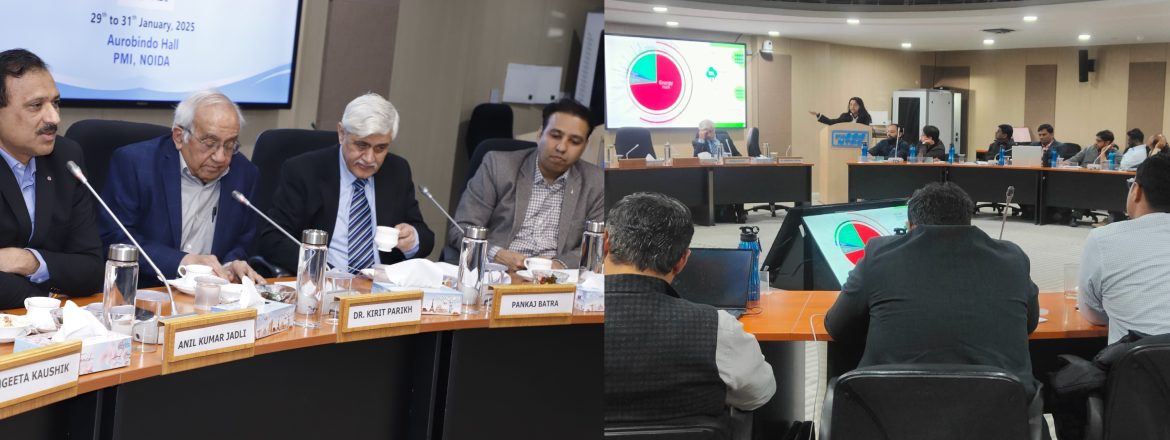
IRADe, in collaboration with the Central Electricity Authority (CEA), co-organised a two-day Capacity Building Workshop for the Western Region Stakeholders on “Resilient, Inclusive, and Environmentally Sustainable Power Sector” in Vadodara, Gujarat on 23rd and 24th January 2025. The workshop aimed to enhance understanding of electricity laws, guidelines, policies, rules, regulations, technologies, and practices among key stakeholders in the Westerm Region.
Prof. Jyoti Parikh, Executive Director of IRADe, emphasised the importance of research, policy-driven action, and capacity building in shaping India’s energy future. She highlighted IRADe’s commitment to advanced modeling and collaboration, ensuring a skilled workforce for a sustainable and resilient power sector.
Mr. Pankaj Batra, Senior Advisor at IRADe emphasized the importance of capacity building for state stakeholders to better understand power sector regulations. He highlighted the Western Region’s leadership in power demand and industry, with Gujarat as a key player. IRADe has initiated regional workshops and webinars to enhance awareness of policies set by MoP, CEA, and CERC. Additionally, customized state-level training will address specific needs, such as TSM, deviation mechanism, and resource adequacy. He encouraged peer learning and collaboration to strengthen India’s power sector.
Prof. Kirit Parikh, Chairman of IRADe, emphasized the need for deeper collaboration between states and the Centre to ensure a sustainable and efficient power future for India. Balancing rising demand, renewable integration, and grid stability through aligned policies and dialogue will be key to a resilient energy transition..
Mr. Somes Bandyopadhyay speaks about Gujarat’s leadership in energy transition
Mr. Somes Bandyopadhyay, MD of GSECL, emphasized Gujarat’s pioneering efforts in transitioning from coal to renewables, battery storage, and nuclear energy. He highlighted the state’s ambitious plans, including over 4,000 MW of pumped storage and the adoption of digital technologies, positioning Gujarat as a leader in India’s energy transformation.
Mr. Ghanshyam Prasad emphasizes the importance of grid stability and renewable integration
Mr. Ghanshyam Prasad, Chairperson of CEA, stressed the critical need for regulatory compliance, grid stability, and large-scale renewable energy integration. He highlighted hydro-pumped storage and nuclear energy expansion as essential solutions for a resilient power sector, along with strengthening cybersecurity and market reforms.
Mr. Upendra Pande highlights challenges and opportunities in India’s power grid transformation
Mr. Upendra Pande, MD of GETCO, spoke about the increasing dominance of renewable energy and the challenges of maintaining grid stability. He emphasized Gujarat’s goal of achieving 100 GW of renewable energy by 2030 and the importance of capacity building, strategic planning, and workforce training to manage energy fluctuations effectively.
Mr. Arun Mahesh Babu focuses on Gujarat’s renewable energy expansion and industrial growth
Mr. Arun Mahesh Babu M.S., MD of GPCL, discussed Gujarat’s renewable energy ambitions, including 18 GW capacity by 2024 and investments in green hydrogen and pumped storage. He highlighted the importance of grid infrastructure upgrades and ensuring reliable power supply for industries like semiconductor hubs and green data centers.
Mr. Lokesh Chandra highlights Maharashtra’s clean energy roadmap
Mr. Lokesh Chandra, CMD of MSEDCL, outlined Maharashtra’s strategic approach to achieving India’s clean energy targets. He emphasized resource adequacy planning, decentralized solar for agriculture, energy storage projects, and demand-side management as key enablers of a resilient and efficient power sector.

